Smart Nutrition: 6 Practical Ways to Eat Better Every Day
Author: RVLNSV PRASAD
Updated On: October 2026
About Us
Author Bio
Editorial Policy
Contact Us
Introduction
Eating well does not have to mean following a complicated diet. Smart nutrition is more about making better food choices consistently while still enjoying the foods you like.
A healthy eating pattern can include vegetables, fruits, whole grains, protein foods, healthy fats, and other nutrient-rich foods. The American Heart Association’s updated 2026 dietary guidance emphasizes an overall eating pattern rather than a single “perfect” food. Its recommendations include eating plenty of vegetables and fruits, choosing whole grains, selecting healthy protein sources, emphasizing unsaturated fats, choosing minimally processed foods, and limiting added sugars and sodium.
American Heart Association — 2026 Dietary Guidance to Improve Cardiovascular Health
That distinction matters.
You do not need to completely change your kitchen overnight. You can start by improving one meal, one snack, or one routine at a time.
Quick Answer: What Is Smart Nutrition?
Smart nutrition means choosing foods and eating habits that provide the nutrients your body needs while fitting your health goals, culture, budget, preferences, and everyday routine.
Instead of asking, “Is this food healthy or unhealthy?” try asking:
What does this food add to my overall eating pattern?
For example, a meal containing vegetables, lentils, rice, and curd can provide fiber, protein, and other nutrients. You do not need to remove rice simply because carbohydrates have become unpopular in some diet trends.
The American Heart Association explains that carbohydrate-containing foods can be part of a healthy eating pattern, particularly when choices emphasize nutrient-rich options such as whole grains, fruits, and vegetables. Its nutrition guidance also emphasizes the importance of nutrients such as protein, fiber, vitamins, minerals, and healthy fats.
American Heart Association — Fuel Your Body Right: Nutrition Basics
That is the basic idea behind practical smart nutrition.
Key Takeaways
- Build meals around nutrient-dense foods.
- Include a useful protein source in your meals.
- Increase vegetables, fruits, and fiber-rich foods gradually.
- Choose whole grains more often than refined grains.
- Reduce frequent reliance on highly processed and ultra-processed foods without treating every packaged food as harmful.
- Pay attention to portions, added sugars, and sodium.
- Improve your food environment so healthier choices become easier.
- Focus on sustainable habits rather than short-term restrictive diets.
The CDC similarly recommends an eating pattern that includes a variety of nutrient-dense foods and emphasizes vegetables, fruits, protein foods, healthy fats, and whole grains while limiting added sugars, sodium, and saturated fats.
CDC — Tips for Maintaining Healthy Weight
What Does Smart Nutrition Actually Mean?
Smart nutrition is not another restrictive diet.
It is a way of thinking about food.
The goal is to create an eating pattern that supplies important nutrients while remaining realistic enough to follow for months and years.
The American Heart Association’s 2026 guidance describes a heart-healthy dietary pattern using several features, including plenty of vegetables and fruits, whole grains, healthy protein sources, unsaturated fats instead of saturated fats, minimally processed foods instead of ultra-processed foods, and lower amounts of added sugars and sodium.
Similarly, Nutrition.gov presents healthy eating as choosing a variety of foods that provide the nutrients your body needs rather than relying on a single food or nutrient.
Nutrition.gov — Healthy Eating
This is important because nutrition is not about one meal.
Your overall pattern matters more.
You could eat a less nutritious meal occasionally and still have a healthy overall diet. Problems usually arise when less nutritious choices become the foundation of your everyday eating pattern.
1. Build Your Meal Around Nutrient-Dense Foods
One of the easiest ways to improve your diet is to ask:
“What nutrients am I getting from this meal?”
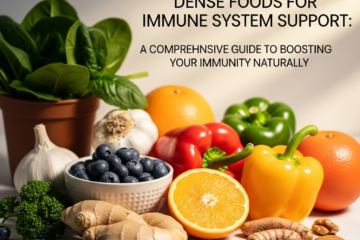
Nutrient-dense foods provide vitamins, minerals, fiber, protein, or other useful nutrients relative to their calorie content.
Examples include:
- Vegetables
- Fruits
- Beans and lentils
- Whole grains
- Eggs
- Fish
- Lean meats
- Soy foods
- Nuts and seeds
- Plain yogurt and other nutritious dairy foods
The American Heart Association recommends eating a variety of vegetables and fruits, choosing whole grains, selecting healthy sources of protein, and emphasizing unsaturated fats as part of a heart-healthy dietary pattern.
The CDC likewise describes a healthy eating plan as one that emphasizes nutrient-dense foods, including vegetables, fruits, protein foods, whole grains, and healthy fats.
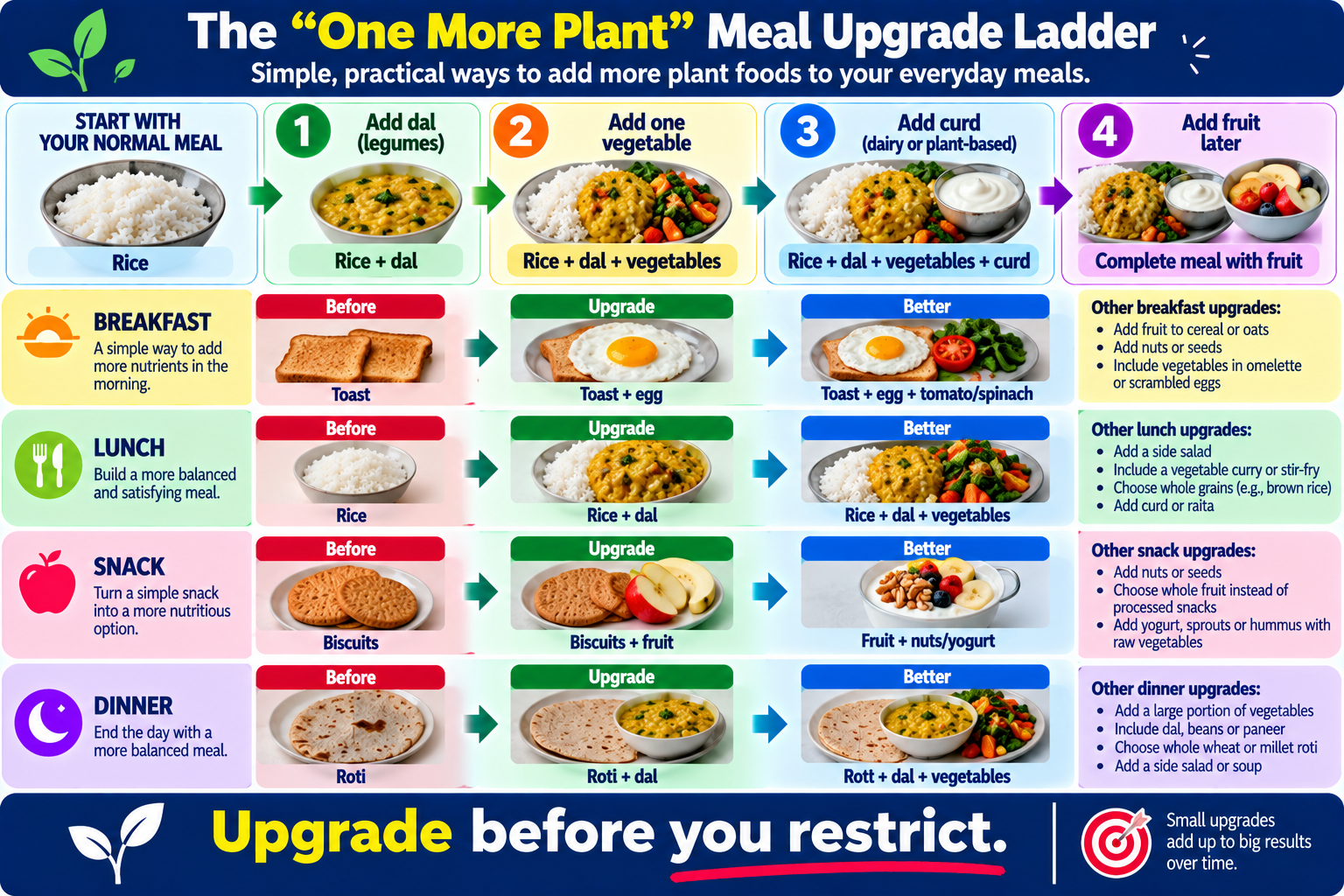
Try the “One More Plant” Method.
You do not have to redesign your entire meal.
Simply add one plant food.
For example:
- Add spinach to an omelet.
- Add cucumber and tomato to lunch.
- Add beans to rice.
- Add fruit to breakfast.
- Add vegetables to noodles.
- Add a handful of vegetables to dal.
This approach works because you are adding quality before removing foods.
That can feel much easier than starting a restrictive diet.
2. Pair Protein With Fiber for More Satisfying Meals
Protein and fiber can contribute to a more satisfying meal.
Protein sources include:
- Eggs
- Fish
- Chicken
- Greek yogurt or curd
- Tofu
- Soy
- Lentils
- Chickpeas
- Beans
- Nuts and seeds
Fiber-rich foods include:
- Vegetables
- Fruits
- Beans
- Lentils
- Whole grains
- Oats
- Seeds
The latest research also suggests that the relationship between cereal fiber and appetite is more nuanced than simply saying that “more fiber always means less hunger.”
A 2026 systematic review examined 48 studies and found that higher cereal-fiber intake was associated with favorable effects on measures of satiety, although effects on actual subsequent energy intake were limited. Rye and oat fibers showed more promising effects than some other fiber types.
PubMed—2026 Systematic Review of Cereal Fibers and Satiety
That gives us a useful practical lesson:
Choose fiber-rich foods regularly, but do not expect one ingredient to control your appetite by itself.
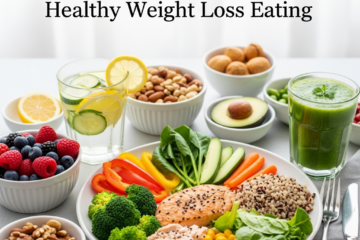
A Simple Meal Formula
Try:
Protein-rich plant food + Whole or minimally refined carbohydrate + Healthy fat
For example:
Dal + vegetables + brown rice + curd
or
Eggs + vegetables + whole-grain toast + fruit
or
Chickpeas + salad + roti + plain yogurt
This is more useful than memorizing a long list of “superfoods.”
3. Choose Whole and Minimally Processed Foods More Often
Processing is not automatically bad.
Frozen vegetables, canned beans, plain yogurt, whole-grain bread, and other packaged foods can still fit into a nutritious eating pattern.
The more useful question is
How often does this food replace more nutritious choices?
The AHA’s 2026 dietary guidance recommends choosing minimally processed foods instead of ultra-processed foods as one component of a heart-healthy dietary pattern.
Research on ultra-processed foods has also expanded rapidly.
A 2026 umbrella review of 26 systematic reviews and meta-analyses examined associations between ultra-processed food consumption and numerous health outcomes. It reported associations between higher consumption and several adverse outcomes, including higher adiposity measures and obesity in children and adolescents.
PubMed — 2026 Umbrella Review of Ultra-Processed Foods and Health Outcomes
An earlier updated umbrella review also examined the broader evidence linking ultra-processed foods with multiple human health outcomes. Because this evidence includes different study designs and outcomes, the strength of evidence is not identical for every health condition.
PubMed — Ultra-Processed Foods and Human Health: Updated Umbrella Review
Use the “Upgrade, Don’t Replace” Strategy.
Instead of saying:
“I will never eat packaged food again.”
try:
“What can I upgrade?”
Examples:
- Sugary cereal → oats with fruit and nuts
- Sweetened yogurt → plain yogurt with fruit
- Refined bread → whole-grain bread
- Sugary drink → water or unsweetened beverage
- Highly processed snack → fruit plus nuts
- Instant meal → add vegetables and a protein source
This makes smart nutrition more realistic.
4. Do Not Treat Carbohydrates as the Enemy
Carbohydrates often become the first food group people remove when trying to eat better.
That is usually an oversimplification.
Carbohydrate-containing foods include fruits, vegetables, legumes, grains, and potatoes. Many of these foods provide fiber, vitamins, minerals, and other useful nutrients.
The American Heart Association’s nutrition guidance explains that carbohydrate-containing foods can provide important nutrients and that the focus should be on choosing nutritious carbohydrate sources rather than simply eliminating carbohydrates.
American Heart Association — Fuel Your Body Right: Nutrition Basics
The better strategy is to consider food quality and portion size.
For example, compare:
- Option A: Large portion of refined carbohydrates with a sugary drink.
- Option B: Moderate portion of rice with dal, vegetables, and curd.
Both contain carbohydrates, but the overall meals are very different.
The CDC specifically advises that healthy eating should include a variety of foods rather than eliminating an entire food group such as carbohydrates.
5. Pay Attention to Added Sugar, Sodium, and Highly Processed Foods
Smart nutrition is not only about what you add.
It is also about what gradually takes over your diet.
Common examples include:
- Sugary drinks
- Sweetened packaged snacks
- Desserts
- Highly processed convenience foods
- Foods high in sodium
- Frequent fried foods
The AHA’s 2026 dietary guidance recommends minimizing added sugars and reducing sodium intake as part of a heart-healthy eating pattern.
American Heart Association — 2026 Dietary Guidance to Improve Cardiovascular Health
This does not mean you need to eliminate every food containing sugar or sodium.
Instead, look at your overall frequency.
Having dessert occasionally is very different from drinking several sugary beverages every day.
A Useful Question
Before buying or eating something regularly, ask:
“Is this becoming an everyday food or an occasional food?”
That simple question can help you identify patterns without creating unnecessary food fear.
6. Make Healthy Eating Easier Through Your Food Environment
Willpower is not the only factor that influences what you eat.
Your environment matters.
If fruit is washed and visible in the kitchen, it may be easier to choose. If snacks are always sitting beside your computer, they may become the automatic option.
This is where smart nutrition becomes practical.
The CDC notes that environmental factors can make healthy eating or physical activity harder, including limited access to healthier foods and suitable places to be active.
CDC — About Healthy Weight and Growth
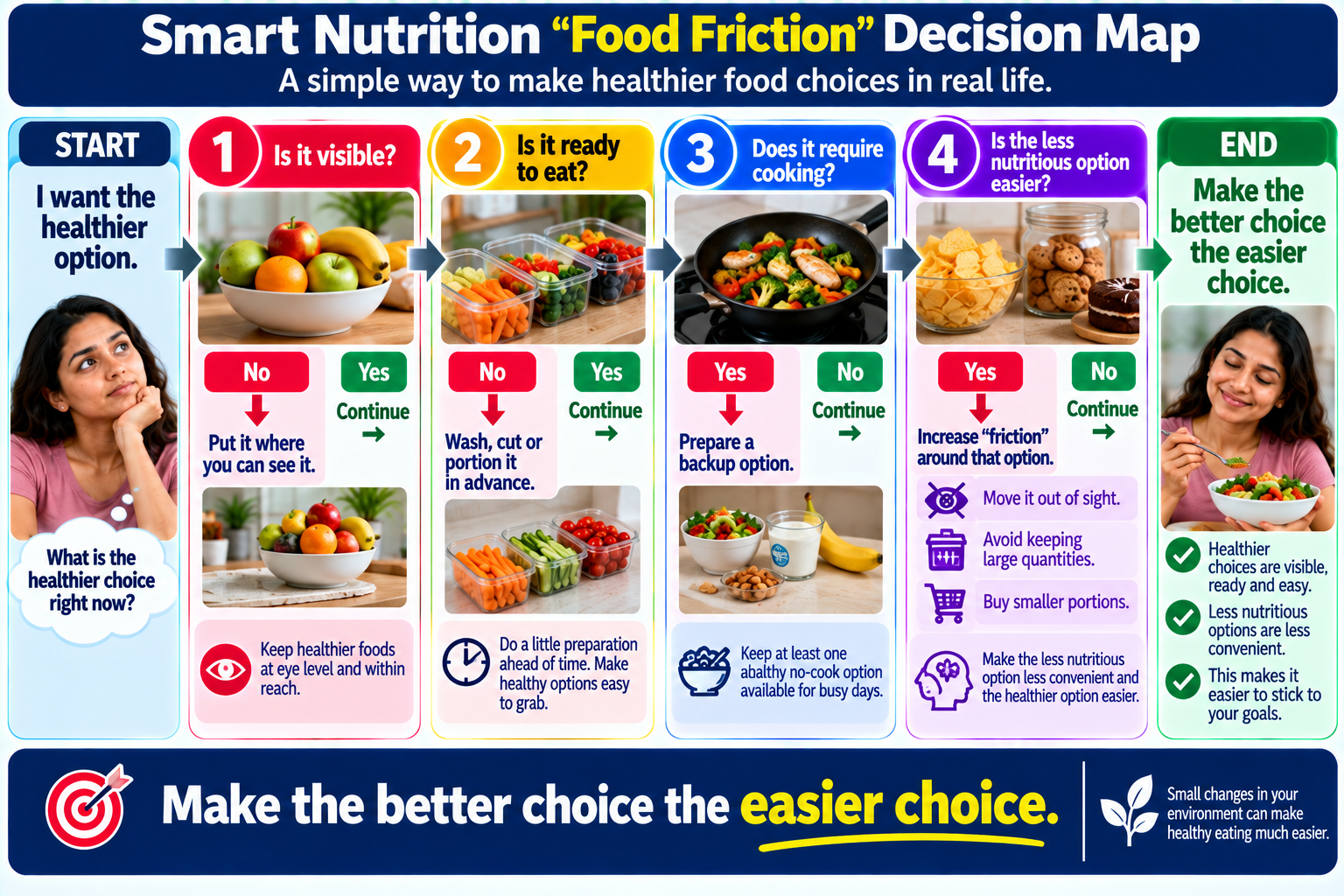
Try the Food Friction Test
For each healthy choice, ask:
How many steps does it take?
For example:
Fruit
Wash → cut → eat.
Healthy snack
Open refrigerator → prepare → eat.
Packaged snack
Open packet → eat.
The easiest option often wins when you are tired.
So reduce the number of steps required for nutritious choices.
Keep fruit visible.
Prepare vegetables in advance.
Keep cooked beans or lentils available.
Store nuts in reasonable portions.
Prepare simple breakfast ingredients before going to bed.
This is one reason I prefer changing the environment instead of depending entirely on motivation.
The Five-Minute Healthy Meal Rescue
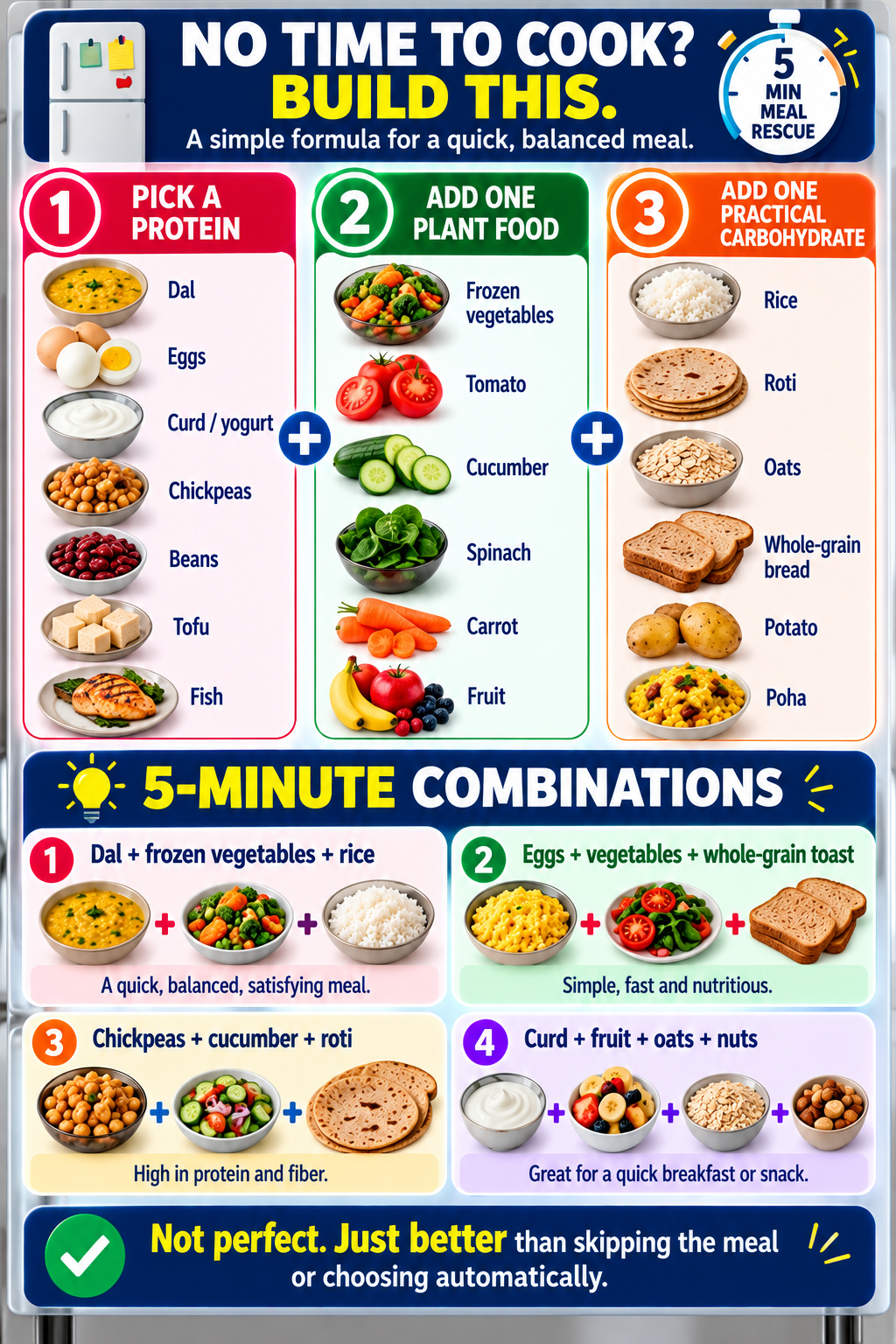
Not every day goes according to plan.
- You may come home late.
- You may have no prepared food.
- You may be too tired to cook.
Instead of ordering the least nutritious option automatically, use a simple emergency formula:
One protein + one plant food + one practical carbohydrate
For example:
Indian option
Dal + frozen vegetables + rice
Vegetarian option
Chickpeas + cucumber/tomato + roti
Egg option
Eggs + vegetables + whole-grain toast
Yogurt option
Plain yogurt + fruit + oats/nuts
The CDC’s 2026 guidance on healthier meals and snacks similarly recommends prioritizing protein foods, vegetables and fruits, healthy fats, and fibre-rich whole grains while limiting highly processed foods and added sugars.
The goal is not culinary perfection; instead, it is to prevent one difficult evening from turning into an entire week of poor eating.
Smart Nutrition for Indian Everyday Meals
You do not need to replace traditional Indian meals with expensive “health foods.”
Many familiar foods can fit into a balanced eating pattern.
Breakfast
Choose options such as
- Vegetable poha
- Idli with sambar
- Oats with fruit and nuts
- Vegetable upma
- Eggs with whole-grain toast
- Dosa with sambar and vegetables
Lunch
A practical plate might include:
- Dal or another protein source
- Vegetables
- Rice or roti
- Curd
- Salad or another vegetable side
Dinner
You could use:
- Roti + dal + vegetables
- Rice + fish + vegetables
- Tofu + vegetables + rice
- Chickpeas + roti + salad
- Vegetable khichdi + curd
The important point is not to label traditional foods as automatically healthy or unhealthy.
Look at the whole meal.
Smart Nutrition and Weight Management
Healthy eating is also connected with weight management, but weight is influenced by more than food alone.
The CDC notes that weight can be affected by physical activity, sleep, age, genes, medications, medical conditions, and environmental factors.
CDC — Tips for Maintaining Healthy Weight
That is why I would not recommend judging your nutrition by the scale alone.
A better set of questions is:
- Am I eating more vegetables?
- Am I getting enough protein?
- Am I choosing fiber-rich foods?
- Am I relying less on sugary drinks?
- Am I eating more mindfully?
- Am I physically active?
- Is my eating pattern realistic enough to maintain?
The CDC’s guidance also emphasizes adequate nutrition, physical activity, and being mindful of calorie intake as components of a healthy lifestyle for weight management.
The Hidden Problem With “Healthy” Packaged Foods
A product can look healthy because its packaging uses words such as:
- Natural
- Multigrain
- Fitness
- Protein
- Organic
- Zero guilt
- High fiber
Those words do not tell you everything.
Read the nutrition label.
Look at:
- Serving size
- Added sugars
- Sodium
- Saturated fat
- Protein
- Fiber
- Ingredients
A “high-protein” snack can still be heavily processed.
Likewise, a simple food such as beans, fruit, oats, or vegetables may not have impressive marketing on the package but can contribute substantially to a nutritious eating pattern.
What Does the Research Say About Ultra-Processed Foods?
This area deserves nuance.
Several recent reviews have found associations between greater consumption of ultra-processed foods and health outcomes such as obesity and metabolic disease.
The 2026 umbrella review found associations between higher ultra-processed food consumption and several adverse health outcomes, although the findings varied across outcomes and populations.
The updated umbrella review in PubMed also examined the broader relationship between ultra-processed foods and human health outcomes.
PubMed — Ultra-Processed Foods and Human Health: Updated Umbrella Review
Research has also examined the relationship between ultra-processed foods and metabolic disease risk.
PubMed — Ultra-Processed Foods and Metabolic Disease Risk
A 2025 updated systematic review and meta-analysis examined prospective cohort studies involving more than 692,000 adults and found that higher ultra-processed food consumption was associated with higher diabetes risk. Importantly, the authors rated the certainty of evidence as very low, so this finding should not be interpreted as proof that ultra-processed foods directly cause diabetes.
PubMed — Ultra-Processed Foods and Diabetes Risk: 2025 Updated Meta-Analysis
But this does not mean:
“Every processed food is unhealthy.”
Nor does it mean:
“Eating one packaged food will cause diabetes.”
The evidence is more complicated.
Your overall dietary pattern, total energy intake, physical activity, sleep, genetics, socioeconomic environment, and other factors all matter.
That is why reduce reliance is generally more practical than fear every packaged food.
A Simple Smart Nutrition Routine
You can make your day easier by using a basic structure.
Morning
Start with a meal that contains protein and fiber.
For example:
Eggs + vegetables + whole-grain toast
or
Oats + yogurt + fruit + nuts
Lunch
Build around:
Protein + vegetables + carbohydrates
For example:
Dal + vegetables + rice
Afternoon
If hungry, choose a practical snack such as
- Fruit
- Plain yogurt
- Nuts
- Roasted chickpeas
- Boiled eggs
Dinner
Keep the same basic structure.
You do not need a completely different diet at night.
Throughout the Day
Drink according to thirst and your individual needs, while remembering that water is generally the simplest low-calorie beverage choice.
A 7-Day Smart Nutrition Starter Plan
Day 1
Add one extra serving of vegetables.
Day 2
Include a protein source at breakfast.
Day 3
Replace one sugary beverage with water or an unsweetened drink.
Day 4
Choose a whole-grain option.
Day 5
Add fruit to one meal or snack.
Day 6
Prepare one healthy food in advance for the next day.
Day 7
Review the week and identify the one change that was easiest to maintain.
Do not try to transform everything at once.
The best habit is often the one you can continue.
Common Smart Nutrition Mistakes
1. Trying to eliminate everything
A highly restrictive plan may work briefly but become difficult to maintain.
The CDC cautions that fad diets can restrict nutritional intake and often fail to provide a sustainable long-term approach.
2. Focusing only on calories
Calories matter, but nutrition quality matters too.
3. Calling carbohydrates unhealthy
The quality and overall amount of carbohydrate-containing foods matter more than simply avoiding the category. The CDC specifically advises against eliminating an entire food group such as carbohydrates because doing so can reduce dietary variety and potentially exclude important nutrients.
4. Buying expensive “health foods”
Many nutritious foods are affordable staples, such as lentils, beans, oats, seasonal vegetables, fruits, and eggs.
5. Depending on supplements
Supplements can have a role when there is a documented deficiency or specific medical indication, but they should not replace a nutritious eating pattern.
6. Expecting immediate results
Nutrition habits influence health over time.
Think in months rather than days.
Latest Research: What Is Changing in Nutrition Advice?
One important change is the growing emphasis on overall dietary patterns rather than individual nutrients.
The American Heart Association’s 2026 scientific statement updates its dietary guidance using newer evidence and continues to emphasize a pattern built around vegetables and fruits, whole grains, healthy proteins, unsaturated fats, and minimally processed foods while limiting added sugars and sodium.
American Heart Association — 2026 Dietary Guidance to Improve Cardiovascular Health
Research into ultra-processed foods is also developing quickly. Recent umbrella reviews have examined evidence across multiple health outcomes, but the results should still be interpreted according to the strength and type of evidence available.
Fiber research is becoming more detailed too. The 2026 systematic review of cereal fibers found generally favorable effects on satiety measures, while also showing that results differed according to the type of fiber.
This supports a broader lesson:
Nutrition is rarely about one magic ingredient.
The pattern matters.
Personal Experience: Why I Prefer Small Nutrition Changes
One thing I have learned while working on health and nutrition content is that people often know what they “should” eat.
The difficult part is doing it consistently.
Someone may understand that vegetables, protein, and whole grains are useful, but that knowledge does not automatically make dinner easier after a long day.
That is why practical changes matter.
Adding vegetables to a familiar meal can be easier than creating an entirely new diet.
Keeping fruit visible can be easier than relying on willpower.
Preparing one protein source ahead of time can make several meals easier.
For me, that is what makes smart nutrition different from another short-term diet.
The goal is not perfection; instead, it is to make the healthier choice easier often enough that it gradually becomes normal.
When Smart Nutrition Needs a More Personalized Approach
General nutrition advice is useful, but it cannot replace individualized medical care.
Your nutritional needs may be different if you have:
- Diabetes
- Kidney disease
- Heart disease
- Gastrointestinal disease
- Food allergies
- A history of eating disorders
- Pregnancy-related nutritional needs
- Significant unintended weight loss or gain
Certain medications and medical conditions can also influence weight and nutritional needs. The CDC specifically notes that medications, medical conditions, genes, age and environmental factors can affect weight management.
If you have a medical condition or are making major dietary changes, discuss your plan with a qualified healthcare professional or registered dietitian.
Frequently Asked Questions
What is smart nutrition?
Smart nutrition is a practical approach to eating that focuses on nutrient-dense foods, balanced meals, appropriate portions, and sustainable habits rather than restrictive dieting.
Is smart nutrition the same as dieting?
No. Dieting often implies a temporary eating plan. Smart nutrition focuses more on an eating pattern that can be maintained over time.
Should I stop eating carbohydrates?
No. Carbohydrates can provide important nutrients and energy. Choose nutrient-rich carbohydrate sources such as whole grains, fruits, vegetables, and legumes more often. The CDC specifically advises against eliminating an entire food group such as carbohydrates.
Are ultra-processed foods always unhealthy?
Not necessarily. Processing exists on a spectrum, and individual foods differ. However, current research has found associations between higher consumption of ultra-processed foods and several adverse health outcomes, so reducing heavy reliance on them can be a reasonable part of an overall healthy eating pattern.
Can smart nutrition help with weight management?
It can support healthy weight management, especially when combined with appropriate physical activity, sleep, and other healthy behaviors. The CDC emphasizes that weight is influenced by several factors rather than food alone.
Do I need expensive superfoods?
No. Nutrient-rich foods can include affordable everyday foods such as lentils, beans, oats, seasonal vegetables, fruits, eggs, and other locally available foods.
What is the easiest place to start?
Start with one meal.
Add a protein source, include a plant food, and choose a practical whole or minimally refined carbohydrate. Then repeat that improvement until it becomes easy.
Author Note
Author: RVLNSV PRASAD
This article focuses on practical nutrition rather than restrictive dieting. Nutrition needs vary between individuals, so general advice should be adapted to personal health conditions, medications, age, activity level, and dietary preferences.
Medical Disclaimer
This article is intended for general educational purposes and does not replace professional medical advice, diagnosis, or treatment. If you have a medical condition, take medication, are pregnant, or have specific nutritional concerns, speak with a qualified healthcare professional before making major dietary changes.
Fitness Disclaimer
Nutrition and physical activity work together, but exercise recommendations should also be individualized. If you have a medical condition, injury, or have been inactive for a long period, seek appropriate professional guidance before beginning a new exercise program.
Final Thoughts
Smart nutrition does not require a perfect diet.
It requires a pattern that gives your body useful nutrients while fitting your real life.
Build meals around vegetables, fruits, protein foods, whole grains, and healthy fats. Reduce your reliance on highly processed foods and frequent sugary foods. Pay attention to portions, but do not become obsessed with numbers.
Most importantly, make healthy choices easier.
The current evidence increasingly supports looking at the overall eating pattern rather than searching for one miracle food or one perfect diet. The AHA’s 2026 guidance reinforces this pattern-based approach, while current research continues to examine how food processing, fiber, and other dietary factors relate to health.
Your best nutrition plan is not necessarily the most complicated one.
It is the one you can realistically follow tomorrow, next week, and months from now.
Sources
- American Heart Association — Fuel Your Body Right: Nutrition Basics
- Nutrition.gov — Healthy Eating
- PubMed — 2026 Umbrella Review of Ultra-Processed Foods and Health Outcomes
- PubMed — Ultra-Processed Foods and Human Health: Updated Umbrella Review
- PubMed — 2026 Systematic Review of Cereal Fibers and Satiety
- PubMed — Ultra-Processed Foods and Metabolic Disease Risk
- PubMed — Ultra-Processed Foods and Diabetes Risk: 2025 Updated Meta-Analysis
- CDC — About Healthy Weight and Growth
- CDC — Tips for Maintaining Healthy Weight
Related Topics
- Healthy Habits Category
- 12 Tips for A Healthy Lifestyle
- Best Weight Loss Nutrition
- Healthy Eating Meal Plan for Wellness
- The Future of Fitness: How AI and Wearable Tech Are Changing Workouts
- Smart Nutrition and Active Living: Keys to a Healthier USA